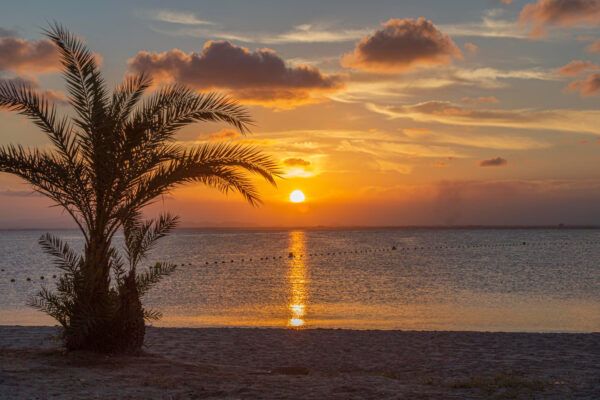
Discover La Manga: a unique place between two seas

Imagine walking in the hills in the morning, swimming from an almost empty sandy beach after lunch and watching the sun set from the opposite shore in the evening. In La Manga, that is not an itinerary invented for a travel advert. It is a perfectly realistic day.
I have known this area for 15 years. I kitesurf, sail, wingfoil, snorkel and walk the coastal paths here, and I travel further inland for via ferrata routes. What keeps bringing me back is not one particular activity. It is the freedom to choose between waves, a shallow lagoon, a long beach, the hills or a few hours of work with the sound of the sea nearby.
La Manga is far less familiar to many international visitors than Alicante, Mallorca or the Costa del Sol. Its geography, however, is one of the most unusual parts of Spain’s Mediterranean coast. This guide is my introduction to what La Manga actually is, when to come and why it works particularly well for people who enjoy sea, nature and an active day.
Two shores on one narrow strip
An aerial view explains La Manga better than a paragraph: the open Mediterranean lies on one side and the shallower Mar Menor lagoon on the other.
La Manga stretches for more than 20 kilometres between the Mediterranean and Mar Menor.
What is La Manga, exactly?
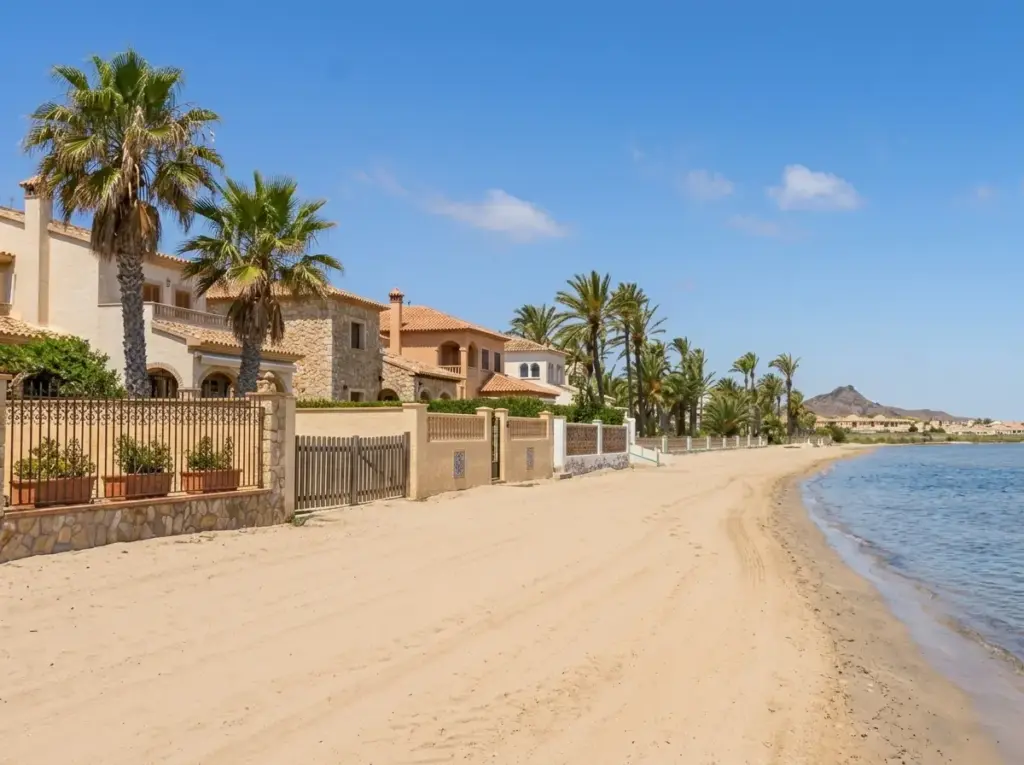
La Manga del Mar Menor is not an island and not a conventional seaside town. It is a narrow sandy strip more than 20 kilometres long. On one side is the Mediterranean; on the other is the Mar Menor, a large saltwater lagoon. In places, walking from one shore to the other takes only a few minutes.
“Between two seas” is therefore more than a slogan. The Mediterranean side has a broad horizon, deeper water and waves in suitable conditions. The Mar Menor is shallow far from shore and usually calmer. Morning light favours one side; sunset belongs to the other.
The attraction is not a single monument or old town. It is the shape and rhythm of the whole place. One useful warning for trip planning: La Manga del Mar Menor is not the same as La Manga Club, the golf resort near Los Belones.
The simplest pleasure: long sandy beaches
There is plenty to do here, but the long beaches remain the most immediate pleasure. Outside the main summer season, I can walk for an hour along the Mediterranean and pass only a handful of people. There is no need to compete for one famous cove or the best square metre beside the water.
On one day I choose the open sea; on another, the calmer Mar Menor. If wind or waves make one side less inviting, crossing the strip can produce completely different conditions. That small daily choice is difficult to appreciate from a map.
A beach with space again
Outside summer, the Mediterranean shore becomes a place for long walks rather than a hunt for somewhere to put a towel. That sense of space is one of La Manga’s strongest qualities.
Replace this with Ernesto’s real spring or autumn beach photograph or a slow shoreline video.

Why I do not recommend July, August or September
I will be direct: if you can choose, I would not make July, August or September your first introduction to La Manga. It is very hot, beaches fill up, traffic slows and finding a parking space can become the day’s unexpected competitive event.
This is one of Spain’s important domestic summer resorts, so it becomes dramatically busier when Spanish families take their holidays. That energetic version of La Manga has many loyal fans. I simply think the landscape, beaches and outdoor activities are easier to enjoy with more space and less heat.
For a detailed comparison, read my month-by-month guide to La Manga.
My choice: April, May, October and November
April and May are comfortable for walking, cycling and water sports. From March through May, I often find more windy days. October and November bring relief from summer heat while still offering plenty of days for the sea and outdoor activities.
On the best autumn days I have seen 25–29°C and gone into the water without a wetsuit while northern Europe was already reaching for winter coats. That is personal experience, not a weather guarantee. June is also an excellent compromise: properly warm, warm water and still relatively few people.
The trade-off is that some seasonal restaurants, cafés and equipment-hire businesses may close or shorten their hours in late autumn and early spring. Check current opening times before making a special journey. For a clearer picture of daily life, continue with my off-season La Manga guide.
Water sports: from a first lesson to waves
Much of La Manga works well for time on the water. There are roughly five useful kitesurfing areas around it, two schools and equipment-hire options. The right place depends on wind direction, experience and the conditions you want.
- Beginners often benefit from the shallow Mar Menor, where learning can feel more manageable.
- Riders looking for waves turn to the Mediterranean side, including the Cabo de Palos area.
- Depending on the wind, options include Isla del Ciervo, Los Nietos, Playa Cavanna and other parts of the coast.
I kitesurf, sail and wingfoil here myself. When the wind arrives, I can spend a couple of hours on the water. When the Mediterranean has suitable waves, surfing becomes an option; Playa de Levante near Cabo de Palos is one known spot. When the wind disappears, I snorkel or swim instead.
The sea is not an amusement park. Check the day’s conditions, local restrictions and your own ability. If you are new to the sport, use a school and instructor.

Choose the water to suit the day
The shallow Mar Menor can suit first lessons, while the Mediterranean produces waves on the right days. I choose the location around wind and experience, not habit.
Use an authentic wide shot that shows the water conditions and coastline, not only the rider.
Hills, wild coastline and the world below the surface
La Manga is not only a beach holiday. Beyond Cabo de Palos, the Calblanque regional park replaces apartment blocks with dunes, cliffs, hills and coastal paths. One of my favourite walks follows the GR-92 from Cala Reona towards Punta Negra and Calblanque. Monte de las Cenizas adds broad coastal views beside the historic Batería de Costa de Cenizas.
Cabo de Palos is excellent for snorkelling and, for experienced divers, scuba diving. The nearby Cabo de Palos–Islas Hormigas marine reserve is protected, so serious dives are best arranged through a licensed local centre that understands permits and zones.
For more height, there are enjoyable via ferrata routes around an hour and a half away by car. There are too many walks and excursions to squeeze into one introduction; start with things to do around La Manga.
From the coastal path straight into the sea
Cala Reona, Calblanque and Cabo de Palos make it possible to combine a walk, wild coastline and snorkelling in one day.
Use Ernesto’s real photograph or short video revealing the coast from the path.

Where I eat, and what I actually recommend
There are many restaurants around La Manga. This is not an internet ranking; it is a short list of places and practical options I have tried myself.
- El Jardín. I often have lunch here. On my recent visits the set lunch was around €15, with genuinely Spanish dishes that are not always familiar to visitors. Dinner costs more but is very good. It stays open all year. I recommend reserving; I normally do it in person because English is not always easy and my Spanish has clear limits.
- La Mestiza. More expensive, but worth it for the food and views. It can close in late autumn or early spring, so check before going.
- Ice Fanático. More café than restaurant: good pancakes and coffee, a modern room, and plenty of desserts and ice cream.
- Mercadona. An unglamorous but genuinely useful budget option. There is hot takeaway food, microwaves and tables. In September 2026, a coffee with milk cost €1.60 and roast chicken with potatoes €4.50. Prices change, but the comparison with restaurant costs is still useful.
- Cabo de Palos. Bocana de Palos is popular locally for seafood and worth trying, although prices are higher. I recommend booking for dinner; lunchtime is easier. La Alpina is a good stop for gelato—tasty, though not cheap.
Many restaurants serve lunch roughly from 12:00 to 15:00, close and reopen for dinner around 19:00. Some operate only in the evening. Days and hours change with the season, so check current information online.

From a set lunch to local seafood
These suggestions come from my own visits, from a good-value lunch to inexpensive hot food at Mercadona and more expensive fish in Cabo de Palos.
Replace this with Ernesto’s authentic food photograph or a short clip in which the dish remains clear.
A car opens up far more of the area
Buses run along La Manga and a cycle lane extends through much of the strip. In a convenient location, daily life does not always require a car. I still recommend one if you want Calblanque, different water-sports locations, the hill paths, Cartagena and Murcia.
For many travellers, flying to Alicante and hiring a car is the simplest route. The drive usually takes around an hour and a half, depending on traffic and the route. I normally compare prices through EconomyCarRentals; I have no commercial connection with it. Whatever site you use, compare the total cost and check the deposit, card and insurance terms.
Cartagena is my first city day trip for its port, historic centre and Roman theatre. An interesting alternative is to drive to Los Nietos and take the local railway, often called the Tren Minero, through La Unión’s old mining landscape to Cartagena. Choose Murcia for a larger city and more shopping. See How to get here and the detailed Alicante Airport transport guide.
One day, several different rhythms
My favourite days mix a morning workout, remote work, time on the water and an evening walk. La Manga makes those changes of pace unusually easy.
A short sequence of gym, work, water and the evening path would tell the story best.

Who is La Manga best for?
I recommend it most to a couple or two independent adults who do not want to spend an entire holiday inside a hotel. It particularly suits people who enjoy long beaches, water sports, walking, remote work or a slower trip outside summer.
It may not suit you if intense nightlife is essential, you want to explore everywhere on foot or you expect every summer bar to remain open in late autumn. I cover those compromises honestly in Who should not choose La Manga for a holiday?
If starting at one shore, spending the day on the water or in the hills and ending with sunset on the other shore sounds appealing, La Manga may surprise you. Just do not arrive at exactly the same time as everyone else.

A simple base for two between two shores
The studio is at kilometre 5. The Mediterranean is about 10 metres from the building, and the Mar Menor is roughly a two-minute walk away.
Use a bright horizontal studio photograph or a short walk from the door towards the Mediterranean.
Would you like to discover La Manga slowly?
I rent a 35 m² studio for two at kilometre 5. It has 600 Mb/s internet, air conditioning and a shared pool that normally operates from late May until the end of October. It is not an all-inclusive hotel; it is a practical base for experiencing La Manga at your own pace.
- 35 m², most comfortable for two guests;
- 600 Mb/s internet for remote work;
- air conditioning;
- shared seasonal pool, normally open from late May to the end of October;
- the Mediterranean about 10 metres away and the Mar Menor about two minutes on foot.
Check the studio and your dates
Start the morning with a swim, return to work or breakfast, and reach Cabo de Palos or Calblanque within a short drive. See the space first, then send a date enquiry if it feels like the right base for your trip.