
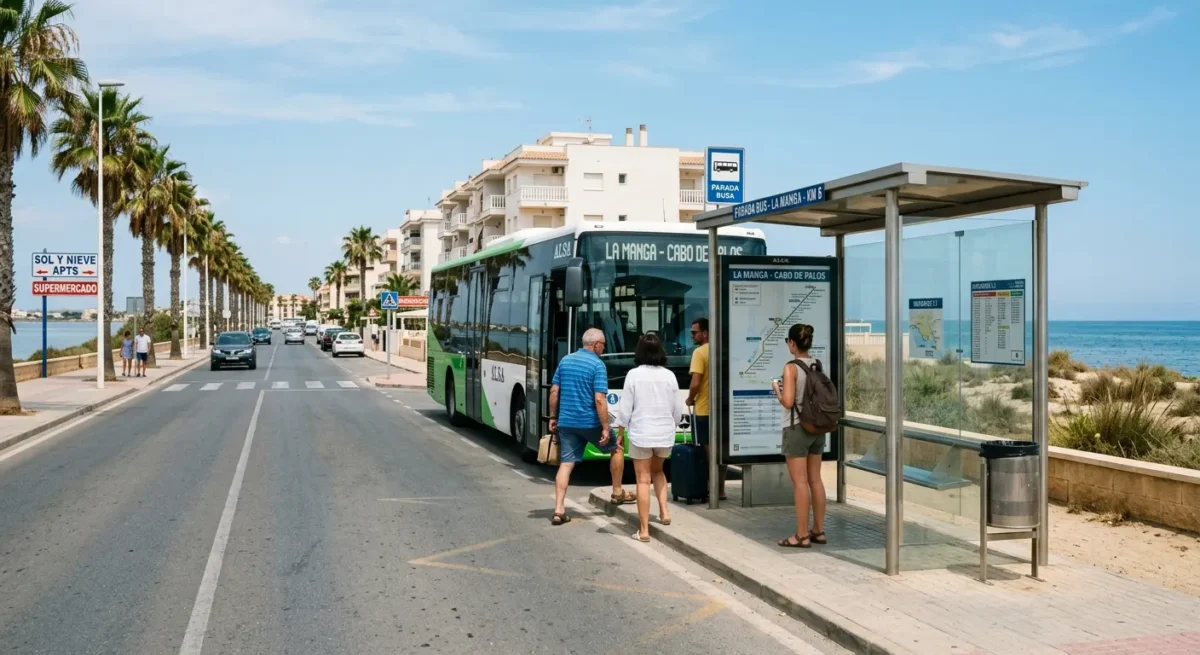
How public transport works in La Manga
La Manga does have public transport, but it is basic and fairly limited compared with a city. In practice, most people who use it are relying on the bus, and whether that feels convenient depends a lot on the season, the time of day, and where along La Manga you need to go. If you are staying here without a car, it can be useful enough for simple daytime trips – I see people use it for that all the time – but it is better to start with realistic expectations than assume you can move around as freely as you would in a larger place.
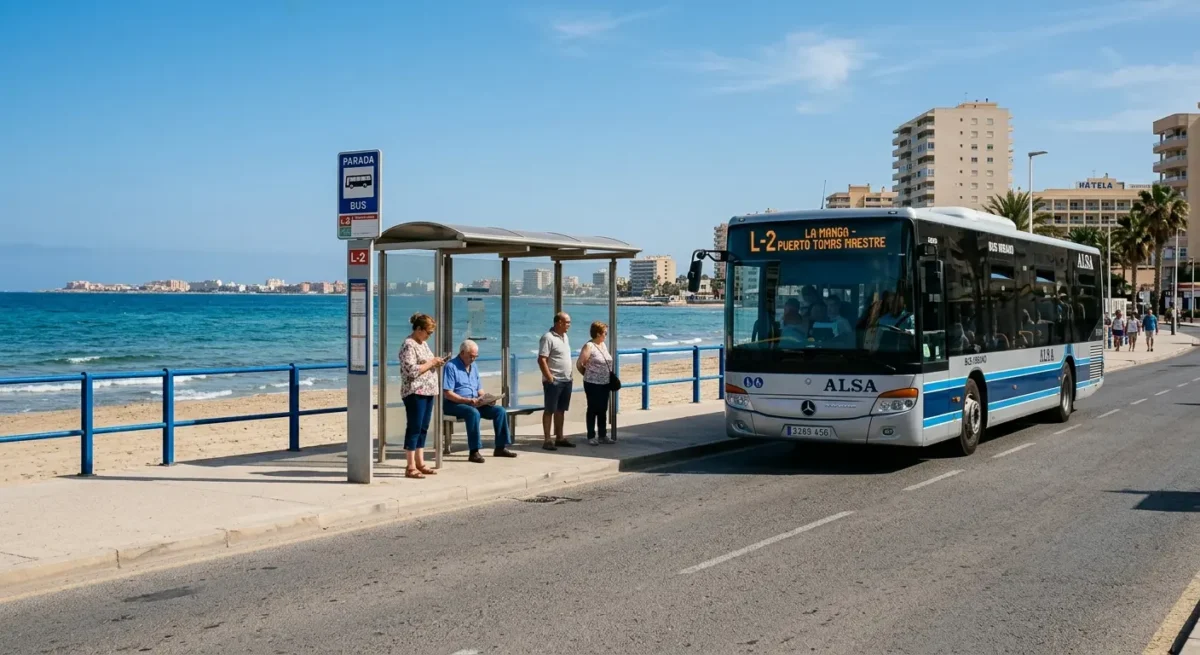
Public transport in La Manga is simple, not wide-ranging
Here, getting around by public transport usually means using the bus, and that works best if your plans are fairly straightforward.
In La Manga, buses are the main form of public transport people use. For most visitors and residents without a car, that is the system you are dealing with. There is public transport, but it is not a broad mix of different options.
The network is quite easy to understand because it is straightforward rather than extensive. In simple terms, that means it covers the main route through La Manga and connects the places most people need, but it does not give you lots of alternative ways to travel if one journey is awkward.
Best for ordinary trips
That setup suits some everyday journeys better than others. If you want to move up and down La Manga during the day, go to shops, beaches, or nearby built-up areas, the bus can be enough. If your plans depend on speed, flexibility, or very specific timings, it starts to feel limited quite quickly.
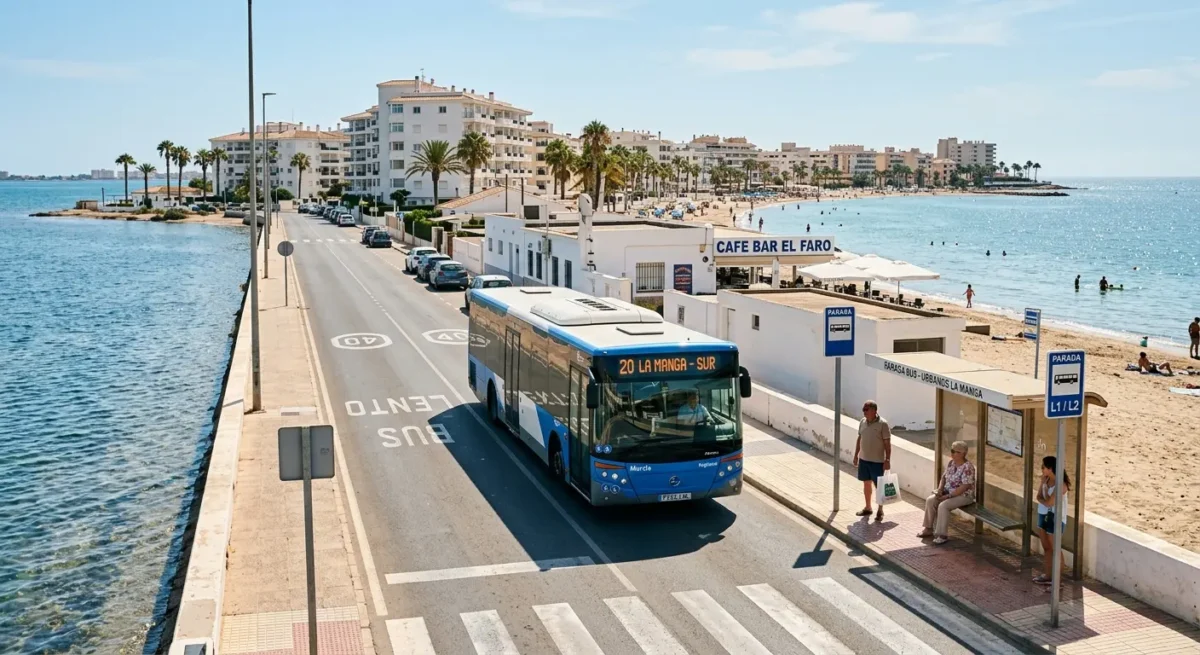
Buses are the main way people get around without a car
In practice, most day-to-day public transport here means catching the bus along the strip.
If you do not have a car in La Manga, the bus is usually the normal way to move from one part of the area to another. That is what local public transport mostly comes down to here. It follows the main built-up line of La Manga, so for ordinary journeys up and down the area, it is the option people tend to use.
In daily life, that usually means short daytime trips rather than anything complicated. People use the bus to get to shops, beaches, cafés, supermarkets, or to meet someone in another part of La Manga. It can work reasonably well when your plans are simple and you are travelling during normal daytime hours.
Useful for straightforward movement
The practical advantage is that you do not need to think in terms of a big transport network. You are mostly using one simple system to move along the length of La Manga. That makes it fairly easy to understand, even if it is not especially flexible. For many people, it is enough for getting from where they are staying to somewhere else nearby without much trouble.
What it does not do particularly well is give you lots of choice. If the bus timing does not suit you, there often is not another public transport option to fall back on. So yes, buses are the main way people get around without a car here, but they suit routine local movement better than precise or time-sensitive plans.
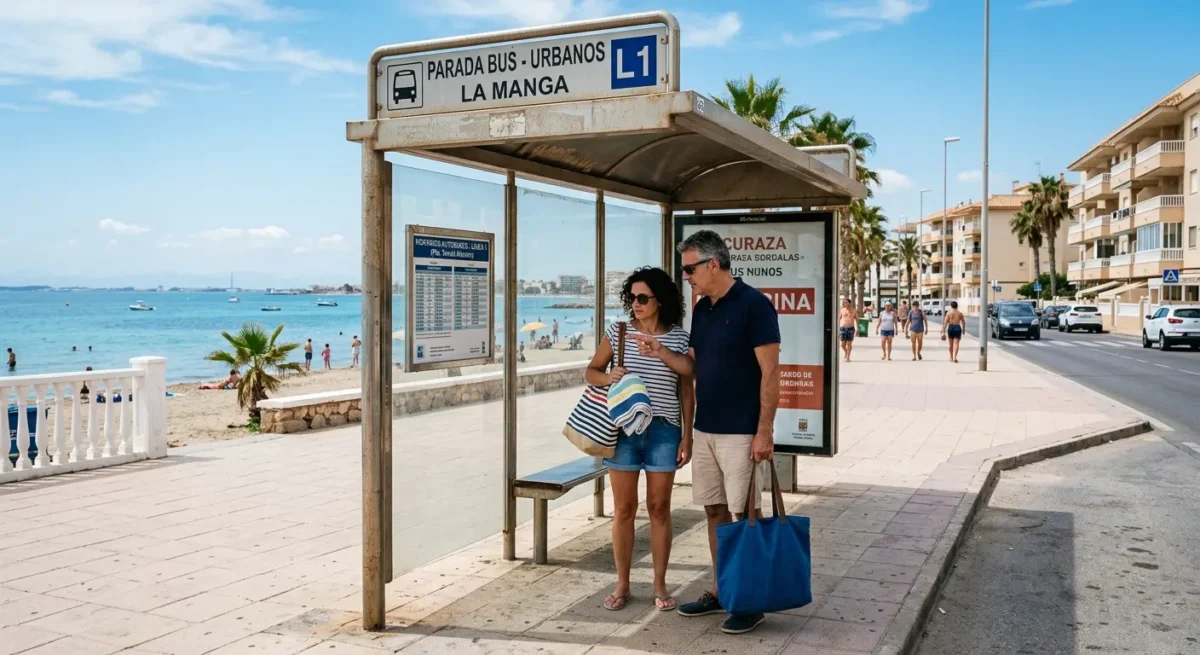
Timetables matter, and they are part of the experience
Using the bus in La Manga usually means checking the schedule and fitting your journey around it
A timetable, meaning the posted schedule showing when buses are meant to run, matters more here than in places with constant service. In La Manga, buses do not just keep appearing every few minutes throughout the day, so the schedule is part of how you travel rather than something you can ignore.
That is why public transport here works best when you plan ahead a little. If you know roughly when you want to leave and check the next bus, the system is usually workable for ordinary trips. If you expect to turn up and leave whenever suits you, it can feel awkward quite quickly.
Workable, but not especially flexible
In day-to-day use, the buses are often reliable enough for simple local movement when you build your plans around the timetable. That does not mean perfectly punctual, and it is better not to assume exact timing. What matters more is that the service is usable if you treat the schedule as something you need to pay attention to.
So the experience is fairly straightforward, but it asks a bit more from you. You are not really buying flexibility. You are accepting a system that can work for daytime travel if your plans are simple and your timing is not too tight.
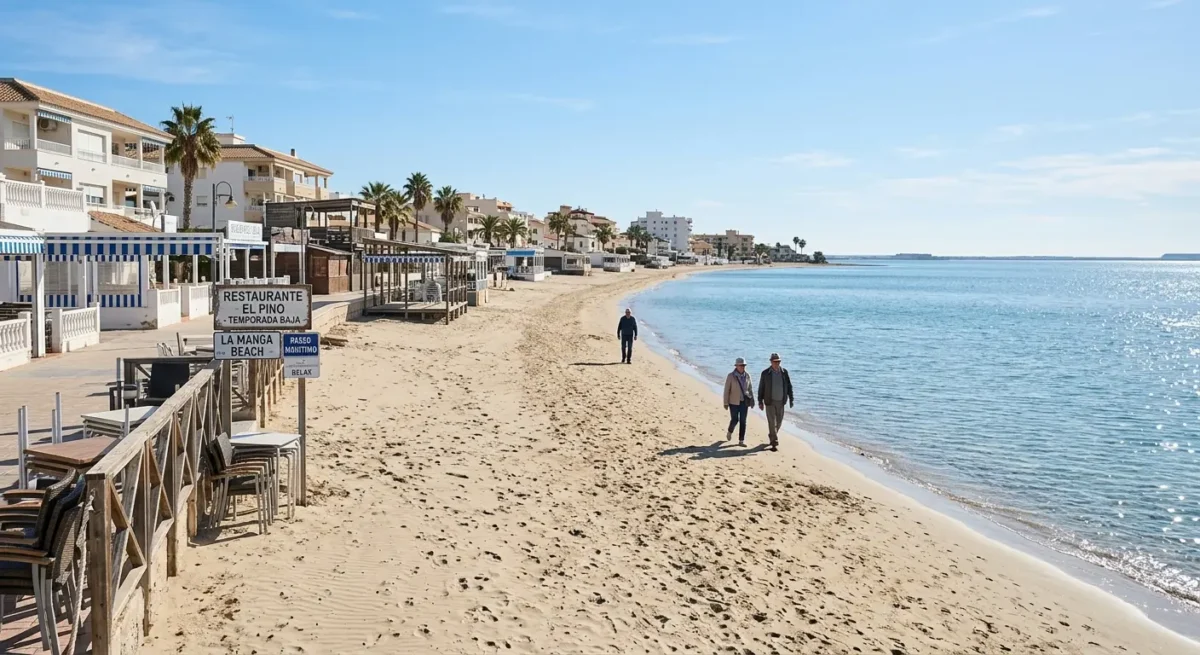
Summer and off season feel very different
Whether the bus feels adequate often depends on the time of year, because demand changes a lot in La Manga.
This is one of the most important things to understand about public transport here. In summer, buses are usually more frequent because La Manga is much busier. There are more visitors, more workers moving around, and more general daytime movement. In that context, the system can feel reasonably practical for ordinary trips up and down the strip.
The same route can feel completely different
Outside the main season, the service tends to feel slower and less convenient. La Manga is quieter, demand drops, and that changes the experience of using the bus. A journey that feels simple in summer can become awkward in the off season, not because the place has changed physically, but because you may be waiting longer and planning around a thinner timetable.
That difference matters in daily life. In summer, you can often treat the bus as a fairly usable way to get to the beach, the shops or another part of La Manga during the day. Off season, the same kind of trip may still be possible, but it asks for more patience and more planning. It is less about hopping on and more about working around what is available.
So if you are judging whether public transport is enough for your stay, do not think of La Manga as having one fixed standard all year. The answer depends heavily on season. In summer it can feel adequate for simple movement. In the off season it often feels much less forgiving.
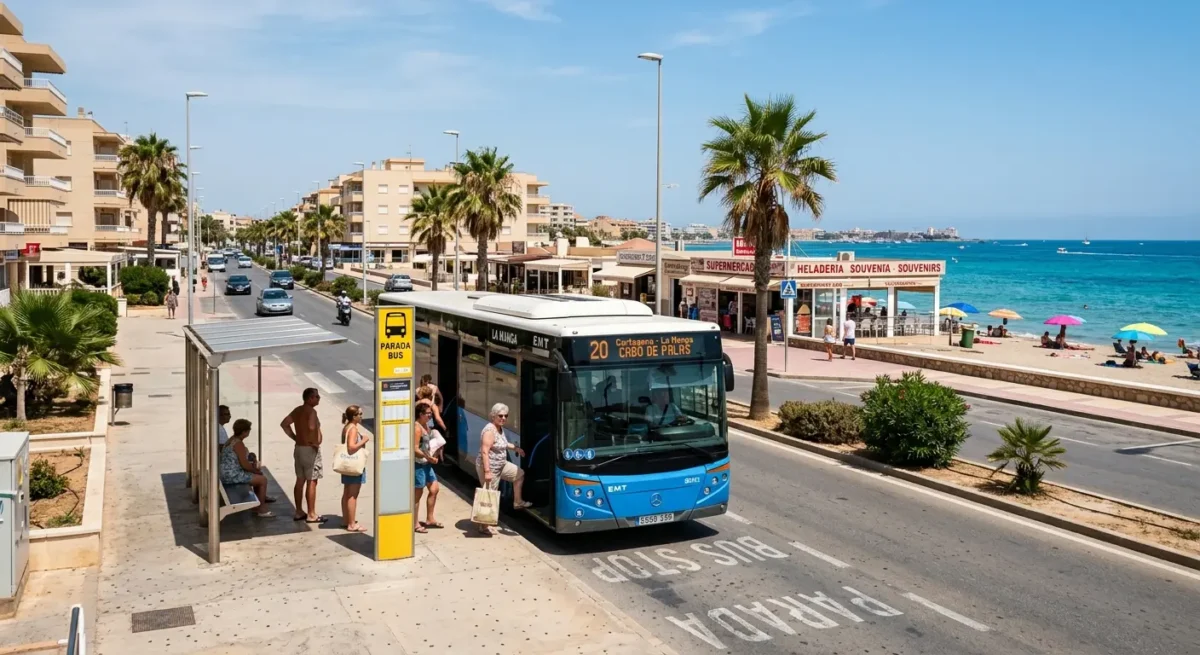
When public transport works well enough
Buses make the most sense for simple daytime trips when you do not mind planning around the timetable.
In practical terms, the bus works best for short trips along La Manga itself. If you are moving between where you are staying, the beach, shops, supermarkets or another nearby area on the strip, it is often good enough. That is especially true in the daytime, when most ordinary movement happens and the service is easier to use.
Best when the journey is simple
It also suits journeys where waiting a bit is acceptable. If you are not trying to arrive at an exact minute, and you can allow for some slack in your plans, the bus is often a sensible option. That might mean going out for lunch, heading to a different beach area, or doing everyday errands without needing the speed or freedom of a car.
Where you are staying still matters. La Manga is long and linear, so some places feel easier to manage by bus than others depending on how close you are to stops and where you need to go. For some people the bus will cover most daytime needs. For others it will only be useful for a few local trips.
So this is really where public transport fits best here: ordinary daytime movement, short distances, and journeys where a bit of waiting does not cause a problem. In those situations, the bus can be perfectly workable. It is just better to see it as a practical tool for certain kinds of trips, not as a flexible answer for everything.

When it starts to become inconvenient
This is the point where the bus still works, but stops feeling easy if you are relying on it for everyday freedom.
The main difficulty is flexibility. During the day, for short local movement, the bus can be enough. But once your plans become more time-sensitive, or you want to move around later in the evening, it often feels less convenient. That does not mean it fails every time. It means you usually have less room for spontaneity.
Late evenings are the weak point
Late evening travel can be awkward, especially if you do not want to finish your day by watching the clock. If you stay out for dinner, meet friends, or spend time outside your immediate area, getting back by bus may take more planning than many visitors expect. For some people that is acceptable. For others it starts to feel restrictive quite quickly.
Long waits can also be part of using the bus, especially outside peak periods. Peak periods simply means the busier parts of the day or year, when services tend to run more often. Outside those times, a missed bus matters more, and a simple journey can turn into a stretch of waiting. That is often manageable if you are not in a hurry, but less so if you are trying to connect plans together.
Longer trips are where patience runs out
Longer journeys, or trips that depend on precise timing, can become frustrating for that reason. La Manga is long, and even when the route is straightforward, the experience is not always quick. If you need to be somewhere at a specific time, or you are covering a bigger distance and hoping for a smooth trip, the bus may feel more limiting than useful. That is often the point where people realise public transport here is workable, but not especially flexible.

What to expect if you plan to rely on it
The bus can cover a fair amount here, but it makes more sense to treat it as workable than flexible.
If you are thinking about staying in La Manga without a car, the honest answer is that public transport can be enough for some people and irritating for others. A lot depends on what you expect from your day. If your plans are simple, mostly local, and mainly during daylight hours, the bus may do what you need. If you want to move around freely without much planning, it is less likely to suit you.
It suits routine better than spontaneity
This is really the clearest way to judge it. People who are happy to organise their day around timetables, nearby stops, and straightforward journeys often manage perfectly well. People who want complete freedom of movement usually notice the limits quite quickly, especially when journeys are longer, later, or less predictable.
Season also changes the experience. In summer, when services are more frequent, relying on the bus feels more realistic. Off season, the same system can feel slower and more restrictive because gaps between buses matter more. Time of day matters in the same way. During the day it is often practical enough. Later on, it can become awkward.
So if your question is whether public transport works in La Manga, the sensible judgement is yes, but within limits. It works best for people whose expectations match the place: short trips, daytime movement, and a willingness to plan ahead. If that sounds fine to you, it may be workable. If not, La Manga can feel quite limiting without a car.
Questions that need to be answered
What locals are talking
We often see the same misunderstanding repeated: people assume public transport in La Manga works with the same freedom all day, then get caught out when the next bus is simply not soon enough for their plans. A common problem is missing one bus and then having to wait much longer than expected, especially outside summer.
My honest view is that public transport here suits people who do not mind adjusting their day around it, but it is not a good fit if you want to move around late, make longer trips easily, or rely on flexible timing.
You might like these too
These sit in the same category as the one you are reading. They follow the same thread and offer a bit more depth. Have a look if you want to go further.